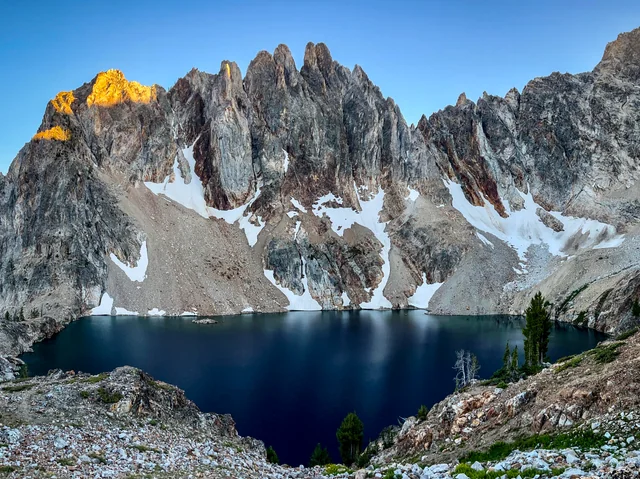
The Sawtooth Mountains MN are one of the most distinctive landscapes along Minnesota’s North Shore of Lake Superior. Stretching roughly from the Carlton Peak area near Tofte toward Grand Marais, this rugged chain of ridges creates the unmistakable jagged profile that gives the range its name.
Unlike the enormous mountain ranges of the western United States, the Sawtooths are relatively modest in elevation. Their appeal comes from something more interesting: ancient volcanic rock, tilted ridges, dense northern forests, dramatic Lake Superior overlooks, waterfalls, and an extensive network of hiking trails.
For travelers, that combination makes the area remarkably versatile. You can spend a few hours hiking to an overlook, explore a state park for an entire day, or use the North Shore as the starting point for a longer backcountry adventure.
What Makes the Sawtooth Mountains MN So Special?
The first thing you notice about the Sawtooth Mountains MN is their shape.
Viewed from Lake Superior or from several North Shore overlooks, the ridges appear as a repeating series of pointed or serrated peaks. That visual pattern is the origin of the “Sawtooth” name. The mountains are not a conventional alpine range with isolated towering summits. Instead, they form a connected landscape of long ridges, steep slopes, valleys, forests, and exposed rock.
Their location makes them even more impressive.
The North Shore places the mountains directly beside Lake Superior, the largest freshwater lake by surface area in the world. In many locations, visitors can look across the lake while standing high above a rocky shoreline.
That creates a landscape with unusual depth. You may have dark forest in the foreground, a dramatic ridge beneath your feet, and an enormous blue lake stretching toward the horizon.
The area also provides access to some of Minnesota’s most popular outdoor destinations, including the Superior Hiking Trail and several state parks.
Where Are the Sawtooth Mountains MN Located?
The Sawtooth Mountains are found along Minnesota’s northeastern North Shore of Lake Superior, primarily in Cook County and the surrounding North Shore Highlands.
The range is commonly described as extending for approximately 30 miles, from the Carlton Peak area near Tofte eastward toward Grand Marais.
Several communities provide convenient access to different portions of the landscape.
Important bases and access points include:
- Tofte
- Lutsen
- Grand Marais
- Schroeder
- Grand Portage
- Two Harbors, farther southwest along the North Shore
The exact experience changes considerably as you travel along Highway 61. Some areas emphasize dramatic lake views, while others lead farther inland into forests, lakes, ridges, and secluded valleys.
For first-time visitors, Tofte, Lutsen, and Grand Marais are particularly useful places to organize a North Shore trip.
How Did the Sawtooth Mountains Form?
The geology is one of the most fascinating reasons to visit the Sawtooth Mountains MN.
The landscape is connected to the ancient Midcontinent Rift, a massive geological event that affected the region around what is now Lake Superior. Enormous quantities of volcanic lava were produced, creating thick sequences of basaltic rock. Some geological interpretations describe hundreds of individual lava flows in the North Shore region.
Over immense periods of time, those volcanic layers were tilted and subsequently exposed to erosion.
The result is a landscape where different rock layers respond differently to weathering and erosion. Harder layers remain prominent while softer material is worn away more quickly.
That process helped produce the long ridges and steep slopes characteristic of the Sawtooth landscape. Geological sources describe the mountains as being shaped from tilted volcanic layers, with erosion revealing the distinctive cuesta-like terrain.
Why Do the Mountains Look Like Saw Teeth?
There is a simple explanation.
The ridges have relatively consistent spacing, angles, and heights when viewed from particular directions. The repeated profile resembles the teeth of a giant saw.
The effect becomes especially noticeable from Lake Superior and certain elevated viewpoints.
Glacial activity also played an important role in shaping the broader North Shore. Repeated glaciations scoured the landscape, altered valleys, exposed bedrock, and helped create many of the lakes and drainage features visible today.
So when you hike through the area, you are not simply walking through a forested mountain range. You are moving across a landscape shaped by volcanism, tectonic processes, erosion, and glaciation over an immense span of geological time.
Which Hiking Trails Are Best Around the Sawtooth Mountains MN?
Hiking is arguably the best way to experience the Sawtooth Mountains MN.
The region is crossed by the Superior Hiking Trail, one of Minnesota’s premier long-distance hiking routes. The trail extends for more than 300 miles from the Minnesota-Wisconsin border toward the Canadian border, passing through numerous North Shore landscapes along the way.
You do not need to hike the entire trail.
That is one of its biggest advantages.
Many sections can be approached as individual day hikes, allowing visitors to experience ridgelines, waterfalls, forests, rivers, and Lake Superior overlooks without committing to a multi-day backpacking trip.
Britton Peak and Carlton Peak Area
The Tofte area is an excellent starting point for hikers interested in mountain views.
Britton Peak is known for relatively accessible scenic hiking and views toward Carlton Peak and Lake Superior. The surrounding trail network provides a good introduction to the terrain without requiring a long-distance expedition.
Carlton Peak is another prominent landmark in the western part of the Sawtooth region.
This area is especially attractive for visitors who want a combination of forest hiking, exposed rock, elevation changes, and panoramic scenery.
Oberg Mountain
Oberg Mountain is one of the better-known North Shore hiking destinations.
Its appeal comes from the combination of forest trails and multiple viewpoints. From elevated sections, hikers can see Lake Superior, surrounding forests, and the distinctive ridges of the region.
It is a particularly good option for travelers who want a memorable viewpoint without planning an extremely long hike.
Tettegouche State Park
Tettegouche State Park is another excellent base for experiencing the rugged North Shore.
The park contains dramatic overlooks, forested trails, waterfalls, lakes, and rocky terrain. Its Shovel Point area provides views along the Lake Superior shoreline toward the Sawtooth Mountains.
The park is also a useful reminder that the Sawtooth landscape is not just about mountain summits. Some of the best experiences happen where ridges meet rivers, cliffs, lakes, and the shoreline.
What Is the Superior Hiking Trail Like?
The Superior Hiking Trail is one of the most important recreational resources associated with the Sawtooth Mountains MN.
The route follows the rugged North Shore landscape and repeatedly climbs toward ridges before descending into river and creek valleys. The official trail organization describes the trail as featuring rock outcroppings, cliffs, forests, waterways, waterfalls, and expansive views.
One important point surprises first-time hikers.
The challenge is not necessarily one enormous mountain climb.
Instead, the trail often involves constant elevation changes.
You might climb a rocky ridge, descend toward a stream, climb again, and then repeat the process several times. That can make a seemingly moderate distance considerably more demanding than its mileage suggests.
For that reason, hikers should judge routes by:
- Total elevation gain
- Trail length
- Terrain
- Weather
- Recent trail conditions
- Available daylight
- Your own fitness and experience
Mileage alone does not tell the whole story.
What Wildlife Can You See?
The North Shore environment supports a wide variety of northern Minnesota wildlife.
Depending on the location and season, visitors may encounter:
- White-tailed deer
- Black bears
- Moose
- Foxes
- Squirrels
- Chipmunks
- Hawks
- Eagles
- Numerous woodland birds
Seeing wildlife is never guaranteed, and hikers should avoid approaching animals.
Black bear awareness is particularly important on longer hikes and backpacking trips. Keep food and scented items properly secured, maintain a respectful distance from wildlife, and follow current land-management guidance.
Ticks are another practical concern during warmer months. The Superior Hiking Trail Association specifically includes trail safety and tick-related considerations in its visitor guidance.
When Is the Best Time to Visit the Sawtooth Mountains MN?
There is no single perfect season.
The right time depends on what you want to do.
Summer
Summer is ideal for conventional hiking, camping, sightseeing, and exploring the North Shore.
The forests are green, trails are generally accessible, and long daylight hours make it easier to plan ambitious outings.
However, summer can also bring insects, humidity, storms, and busy weekends.
Autumn
For many visitors, fall is the most spectacular season.
The North Shore forests become intensely colorful, creating a sharp contrast with the dark rock and deep blue waters of Lake Superior.
If photography is your priority, autumn can be exceptional.
The trade-off is that popular viewpoints and trails can become considerably busier during peak foliage.
Winter
Winter transforms the Sawtooth Mountains MN into a completely different landscape.
Snow covers the forest floor and ridges, while ice can form around waterfalls and rocky shorelines. Nearby Lutsen Mountains also provides winter skiing and snowboarding opportunities in the Sawtooth region.
Winter travel requires substantially more preparation, though.
Cold temperatures, snow-covered trails, limited daylight, icy surfaces, and rapidly changing weather can turn a simple summer hike into a serious winter outing.
Spring
Spring can be beautiful but unpredictable.
Snowmelt increases water flow in rivers and waterfalls, while muddy trails can make hiking slower and harder.
Always check current trail conditions before setting out.
What Should You Bring for a Sawtooth Mountains Hike?
A short scenic hike and a full-day backcountry outing require different levels of preparation.
For a typical day hike, consider carrying:
- Water
- Food or high-energy snacks
- A detailed trail map
- Weather-appropriate clothing
- Rain protection
- A small first-aid kit
- Phone and backup battery
- Headlamp
- Insect protection
- Emergency supplies
Good footwear matters.
Rocky and uneven terrain can become slippery after rain, while roots, mud, exposed rock, and steep sections can make ordinary sneakers uncomfortable or unsafe.
For longer hikes, add extra food, navigation equipment, insulation, and emergency gear.
The Superior Hiking Trail Association also recommends becoming familiar with navigation, trail conditions, campsites, crossings, and Leave No Trace principles before heading out.
Are the Sawtooth Mountains MN Good for Families?
Yes, but route selection matters.
The entire region should not be treated as one difficulty level.
Some overlooks and short trails are manageable for families with older children, while longer Superior Hiking Trail sections can involve steep climbs, exposed rock, and repeated elevation changes.
A smart approach is to choose the destination first rather than simply searching for “a Sawtooth hike.”
Ask:
How long do we want to walk?
How much elevation can everyone comfortably handle?
Do we want a waterfall, lake, forest, or panoramic overlook?
What is the weather doing?
Those questions will usually produce a much better experience than choosing a trail based solely on photographs.
What Other Attractions Are Near the Sawtooth Mountains?
One of the strongest reasons to visit this part of Minnesota is the sheer number of attractions packed into the North Shore.
You can combine a mountain hike with:
- Lake Superior shoreline stops
- Waterfalls
- State parks
- Scenic overlooks
- Lutsen Mountains
- Grand Marais
- Historic sites
- Camping
- Scenic Highway 61 drives
- Cross-country skiing
- Snowshoeing
- Mountain biking in suitable areas
The North Shore is especially well suited to road trips.
Rather than staying in one location for the entire vacation, travelers can move between trailheads, parks, overlooks, and small communities.
Explore Minnesota highlights the Superior Hiking Trail as one of the region’s signature experiences because visitors can choose shorter hikes or longer rugged sections while enjoying views of Lake Superior and the Sawtooth Mountains.
How Can You Plan a Better Sawtooth Mountains MN Trip?
A little planning can dramatically improve the experience.
1. Choose Your Base
Tofte, Lutsen, and Grand Marais are useful bases for exploring different parts of the North Shore.
2. Pick Trails by Difficulty
Do not assume every Sawtooth trail is easy because the mountains are relatively low.
Elevation changes and rocky surfaces can make short hikes surprisingly demanding.
3. Check Conditions
Weather and trail conditions can change quickly.
Check official trail and park information before leaving.
4. Start Early
Morning starts give you more daylight and can reduce congestion at popular trailheads and viewpoints.
5. Leave a Flexible Schedule
Do not pack every hour of your trip.
If weather closes one trail or you discover a beautiful overlook along Highway 61, flexibility lets you change plans without stress.
6. Respect the Landscape
Stay on established trails, pack out waste, protect vegetation, and avoid disturbing wildlife.
The scenery is impressive partly because it has survived for generations. Good visitors help keep it that way.
Is the Sawtooth Mountains Area Worth Visiting?
Absolutely.
The Sawtooth Mountains MN offer something that many destinations struggle to create: a strong sense of scale without requiring extreme mountaineering.
You can stand on a rocky ridge and look across Lake Superior, walk through northern forest, descend beside a waterfall, and later drive along one of America’s most scenic lakefront highways.
The geology adds another layer to the experience.
Those ridges are physical evidence of ancient volcanic activity and geological forces that operated long before Minnesota looked anything like it does today. The combination of tilted lava flows, erosion, glacial modification, and Lake Superior creates a landscape that is both beautiful and scientifically fascinating.
For hikers, photographers, families, road trippers, skiers, and outdoor enthusiasts, that variety is the real attraction.
Frequently Asked Questions About Sawtooth Mountains MN
1. Where are the Sawtooth Mountains in Minnesota?
The Sawtooth Mountains are located along the North Shore of Lake Superior in northeastern Minnesota. They extend roughly from the Carlton Peak area near Tofte toward Grand Marais and form part of the North Shore Highlands.
2. Why are they called the Sawtooth Mountains?
They are called the Sawtooth Mountains because their repeated ridges and peaks create a serrated profile that resembles the teeth of a saw when viewed from certain directions.
3. Can you hike in the Sawtooth Mountains?
Yes. The region contains numerous hiking opportunities, including sections of the Superior Hiking Trail and trails within nearby state parks. The terrain ranges from relatively accessible day hikes to demanding routes involving significant elevation changes.
4. What is the best season to visit?
Summer is excellent for hiking and camping, while autumn is particularly attractive for fall colors. Winter offers snow-based recreation, including skiing in the Lutsen area. Spring can be rewarding for waterfalls but may bring muddy and variable trail conditions.
5. Are the Sawtooth Mountains actual mountains?
They are commonly called mountains, although their elevations are much lower than major mountain ranges such as the Rockies. Their rugged appearance comes from long, tilted volcanic ridges, steep slopes, erosion, and glacial shaping rather than extreme elevation.
Conclusion: Experience the Sawtooth Mountains Beyond the Viewpoint
The Sawtooth Mountains MN are much more than a scenic backdrop along Lake Superior.
They are a geological story written into rock, a hiking destination filled with ridges and valleys, and one of the most visually distinctive landscapes in Minnesota. Their combination of ancient volcanic terrain, northern forest, waterfalls, Lake Superior views, and extensive trails gives visitors countless ways to explore.
If you are planning your first trip, start with a manageable hike and one or two major viewpoints. Give yourself enough time to slow down, study the landscape, and appreciate how the ridges interact with the lake.
And if you have more time, go deeper.
Explore another trail. Visit a state park. Follow the North Shore farther toward Grand Marais. Experience the landscape in a different season.
That is the real strength of the Sawtooth Mountains MN: one visit can introduce you to the scenery, but several visits reveal how much more there is to discover.